七种方案,经过考量
2026年7月20日
Axios 对新模型的报道
三周前,我在此处发出警告:
“自2023年夏季以来,我在此定期阐述的‘无护城河 → 更多竞争者 → 价格战 → 利润稀缺’这一论点,其最终结局已经到来——并可能摧毁美国AI产业。”
上周,中国公司月之暗面(Moonshot.AI)发布了一款名为 Kimi K3 的模型,该模型在很大程度上与美国最优秀的模型不相上下,但与这些模型不同的是,它是一款“开放权重”模型,消费者可以免费下载并在本地运行(前提是拥有支持其运行的大规模硬件)。上周五,美国股市部分因这一消息而下跌,其影响可能极为深远。这绝非偶然。此前不久,智谱(Z.ai)的 GLM 5.2 模型也引发了震动。阿里巴巴的新款通义千问(Qwen)模型可能会进一步加剧这种颠覆。
这一切都对 OpenAI 和 Anthropic 的商业模式提出了严重质疑,并可能扼杀或严重削弱它们的IPO。同时,这也让“美国可能‘赢得’AI竞赛”这一本就站不住脚的想法更加令人怀疑。
Ryan Fedasuak(他后来在CNN上讨论了此事)对此表示了一些惊讶:
Ryan Fedasiuk@RyanFedasiuk 我们不能忽视刚刚发生的事情。美国在AI软件领域的护城河并不像我们许多人希望的那样坚固。是时候认清AI竞赛的真正本质了:这是一场构建和部署算力的工业体系竞争。我最新发表在@AEI上的文章:aei.org/foreign-and-de… 2026年7月17日下午3:08 · 49.9万次浏览 * * * 28条回复 · 43次转发 · 168个赞 但这并不应该让任何人感到意外。我在2025年1月DeepSeek发布后写的那篇文章——上周有位读者称其“准得可怕”——几乎已经将一切阐述清楚了。当时我警告说:
如果美国继续主要聚焦于大语言模型,将无法在对华AI竞赛中取得决定性胜利
相反,我们最终会打成平手
缺乏技术护城河将意味着像OpenAI这样的公司会持续无法盈利
英伟达将面临风险
《芯片法案》会适得其反,且无法有效遏制中国
模型会持续变得更高效、更廉价,但模型幻觉和可靠性问题仍将存在。
无休止地围绕大语言模型展开竞赛,会消耗本可用于开发更具原创性想法的资源。
这基本上就是已经发生的情况。我真希望当初有更多人听进去。
他们没听进去,这在一个与硅谷缺乏距离、且极少征求外部意见的政府中,几乎是不可避免的。美国将硅谷的幻想当作现实,犯下了巨大的错误;如今经济岌岌可危,他们支持的那些公司似乎已无足轻重,而中国似乎已准备好进一步削弱这些公司。我们一开始就不该孤注一掷地押注生成式AI,这项技术从一开始就似乎并未提供多少技术护城河。
一堆廉价且带有仇外心理的对中国的轻蔑言论,让我们一无所获。
问题在于,我们现在该怎么办?
首先,国会应当展开调查。美国是如何浪费其领先优势的?是否存在战略或战术上的失误?孤注一掷地押注一项可以被复制的单一技术是否愚蠢?美国公司是否充分保护了其知识产权?中国政府是否在补贴其国内公司,补贴程度如何?是否存在来自中国的间谍活动?美国公司是否做出了正确的选择?对美国公司的投资更可能盈利还是亏损?移民限制是否适得其反,导致了人才流失?(月之暗面的创始人曾就读于卡内基梅隆大学,之后回到了中国。为什么?)对于下一轮人工智能迭代,或量子计算、核聚变等未来技术,是否有经验教训可以吸取?
但调查不会让我们走得太远。真正的问题在于战略层面。
以下是特朗普政府可能考虑的七个选项,最后以一个长期来看可能比前七个选项更能造福世界的“王牌”选项作为结尾。
什么都不做。让 OpenAI 和 Anthropic 自力更生。没有政府补贴或变相救助。如果 OpenAI 和 Anthropic 能找到繁荣发展的方式,例如专注于狭窄的垂直领域,或针对个别大客户的“前向部署”,那很好。如果他们倒闭了,那也顺其自然。谷歌、微软和亚马逊不会消失,它们可以满足美国的需求,尤其是那些中国模型可能不受欢迎的机密需求。然而,这可能会将大量 AI 市场拱手让给中国,因此并不理想。
取缔开源。祝你好运;至少在 LLM 方面,木已成舟。(而且即使这是非法的,目前它也会在暗网和没有禁止它的国家继续蓬勃发展。)
**构建监管护城河**,作为保护美国公司的变相手段。上周末,刚加入 OpenAI 的 Dean Ball 似乎认为这就是未来的发展方向。¹ 我希望不是。正如 Will Manidis 所说,这将是保护主义,“……一项利用晚期官僚国家非正式、强制性的权力,为 OpenAI 或 Anthropic 清除美国市场上更便宜的前沿竞争对手的提议。”这也可能会压垮美国初创公司。用 Matt Stoller 的话说,这是用“企业共产主义”取代开放和竞争的市场。这无疑会减缓进步并推高价格,以牺牲成千上万其他公司的利益来帮助两家美国公司。
救助大型 AI 实验室。绝对不行:
 5. 全面禁止中国模型。Axios 认为这可能正在酝酿之中。这是上述方案的变种;肯定会提高消费者的价格,并扼杀创新。
 甚至在读到上述传闻之前,我就在 X 上对此开了个玩笑:
 正如投资者兼 CEO Phil Libin 今早在给我的信息中所说,“当资本、思想和人员自由流动时,美国体系就会受益。我们不需要去‘赢’一场零和游戏。我们通过将游戏转变为非零和游戏来获胜。这是我们赢得 20 世纪的方式,也是我们赢得 21 世纪的最佳机会。”
干脆以极低的价格——按两分钱兑一美元的比例——将大型AI实验室OpenAI和Anthropic整体收购,这已经算慷慨了,因为这两家公司在尚未令人信服地实现盈利的行业里,基本上都是亏损企业。把它们改造成国家实验室,通过竞争性程序向所有经认证的科学家开放。由于AI建立在很大程度上未经补偿便取用的人类知识产权之上,这当中也带有一种诗意的正义。不利的一面在于,政府可能会利用这些数据做不光彩的事,例如大规模监控。鉴于赫格塞斯曾抨击Anthropic拒绝做这类事,也鉴于现政府倾向于以薄弱理由起诉批评者和敌人,我们应当警惕政府滥用权力。
放弃“赢得”AI战争的零和博弈努力,转而致力于将AI打造为全球公共产品。2017年,我在《纽约时报》(基于2016年在“AI向善”会议上的演讲)中提出了“AI领域的欧洲核子研究中心(CERN)”构想,写道:
我羡慕地看待我在高能物理学界的同行,尤其是欧洲核子研究中心(CERN)——一个庞大的国际合作机构,拥有数千名科学家和数十亿美元资金。他们追求雄心勃勃、定义明确的项目(比如利用大型强子对撞机发现希格斯玻色子),并与全世界分享成果,而非将其局限于某个国家或公司……一项国际性的AI使命……确实能让世界变得更好——如果它让AI成为公共产品,而非少数特权者的财产,那就更是如此。
也许现在就是那个时刻?长期以来,实现这一目标的可能性似乎渺茫,但或许时机已到。从习近平主席刚刚发表的一篇演讲来看,中国本身似乎对此类做法持欢迎态度,这是他首次在AI会议上担任主旨演讲人。
我不知道是否该把习主席的话当真——你可以在这里观看他的完整演讲——但他提到这一点,为讨论打开了巨大的空间。我仍然认为,将人工智能置于公共领域,并借助国际力量推动医学和科学发展,会是一个好主意。在我讨论过的各种选项中,这在我看来是最有希望的,是一种将人工智能——它建立在大量源自公众辛勤劳动和思考、且大多未获报酬的互联网内容之上——真正转化为全球公共福祉的最后手段。
如果特朗普真的想赢得诺贝尔和平奖,这可能是他的机会。一项禁止闭源人工智能的决定——要求所有制造商向经认证的科学家和研究机构共享其权重、架构和训练数据——再加上与中国达成协议,让人工智能致力于公共福祉——这将是给人类的一份伟大礼物。
加里·马库斯在2016年提出了一个“人工智能领域的欧洲核子研究中心(CERN)”的构想,并在2023年参议院会议上温和地重提了这一想法。如果能看到这个构想的某种变体得以实现,他会非常激动。
在随后的一条推文中,迪恩声称他并非提议美国设置监管壁垒将中国排除在外,只是陈述这是不可避免的。(X平台上几乎没人相信他;大多数人认为他是在巨大反对声浪面前退缩了。我对其意图不予置评。)
关于此帖的讨论
美国在量子计算领域也不会赢……如果它不能造福人类,那谁能算赢?
为什么总是提到中国?世界各地都在开发开放模型,所有开源技术都是全球范围内开发的。
认为可以禁止机器学习或任何其他领域的开放开发,这种想法是愚蠢且荒谬的。其他地方的人完全可以创建自己版本的同类东西,换个名字,甚至可能进一步改进它。
企业级机器学习的未来,是为特定用例创建和训练的模型,使用自有硬件,这将带来可预测(且易于控制)的成本。因此,投资回报率将很容易计算,并且除了硬件制造商之外,或许真的有人能从中获利。
赞回复
Seven options, considered
Jul 20, 2026
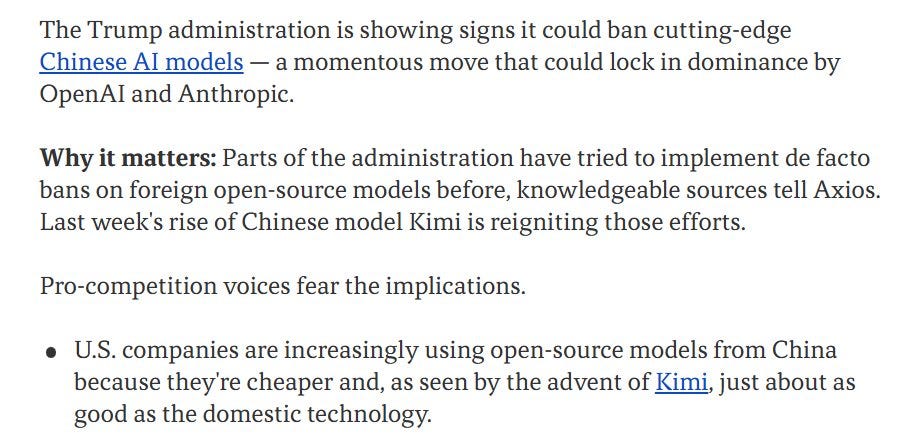
Axios coverage of the new model
Three weeks ago,I warned here that
“The ultimate culmination of the “no moat => more competitors => price wars => profits are scarce” argument that I have been making here regularly since the summer of 2023, has arrived — and may wreck the U.S. AI industry”
Last week, the Chinese company Moonshot.AI announced a model called Kimi K3 that is largely on a par with the best American models, and unlike those models, it is an “open weight” model that consumers will be able to download to run locally (if they have the large-scale hardware to support it) for free. The US stock market dropped partly on this news Friday, and the repercussion are likely to be immense. It’s no fluke, either. Chinese model GLM 5.2 from Z.ai made shockwaves not long before. Alibaba’s new Qwen model may add to the disruption.
All this calls the business models of OpenAI and Anthropic into serious question, and may kill or greatly undermine their IPOs. It also casts serious doubt on the never-too-plausible idea that America might “win” the AI race.
Ryan Fedasuak (who later went on CNN to discuss) expressed some surprise at this:
Ryan Fedasiuk@RyanFedasiuk We can’t ignore what just happened. The American moat in AI software is not as strong as many of us had hoped. It’s time to recognize the AI race for what it really is: an industrial systems competition to build and install compute. My latest for @AEI: aei.org/foreign-and-de… 3:08 PM · Jul 17, 2026 · 49.9K Views * * * 28 Replies · 43 Reposts · 168 Likes But it’s not like anyone should be surprised. The essay I wrote in January 2025 after DeepSeek came out — which one reader last week called “scarily accurate” — pretty much laid it all out. At the time I warned that
the US would not achieve a decisive victory in AI over China if they continued to focus largely on LLMs
that we would instead converge on a tie
that the lack of a technical moat would mean that companies like OpenAI would remain unprofitable.
that Nvidia would be vulnerable
that the CHIPS act would backfire, without doing much to hold China back
that models will continue to get more efficient and less expensive, but that hallucinations and reliability problems will persist.
that racing endlessly around LLMs would sap resources that could instead go into developing more original ideas.
That’s basically what has happened. I wish more people had listened.
That they didn’t is probably inevitable in government that lacked distance from Silicon Valley, and rarely consulted anyone for an outside opinion. By treating Silicon Valley fantasies as real, US government has massively blundered; the economy is now precarious, the companies they supported seem marginal, and China seems poised to undercut those companies further. We should never have gone all-in on GenAI, which never seemed to offer much in the way of a technical moat, in the first place.
A bunch of cheap xenophobic dismissals of China got us nowhere.
The question is what should we do now?
Well, to begin with, Congress ought to investigate. How did the US squander its lead? Were there strategical or tactical errors made? Was going all in on a single technology that could be replicated foolish? Did US companies do enough to protect their IP? Is the Chinese government subsidizing the Chinese companies, and to what degree? Is espionage from China involved? Are the US companies making good choices? Would investments in US companies likely make money or lose money? Have restrictions on immigration backfired, leading to a talent drain? (Kimi’s founder went to Carnegie Mellon and returned to China. Why?) Are there lessons to be learned for the next iteration of AI, or future technologies such as quantum computation or fusion?
But investigation won’t take us far. The real questions are strategic.
Here are seven options the Trump administration might consider, ending with a wild card that long-term might do more for the world than any of the first seven.
Do nothing. Let OpenAI and Anthropic stand on their own feet. No government subsidies or backdoor bailouts. If OpenAI and Anthropic can find a way to thrive, e.g., by focusing on narrow verticals, or “forward deployment” focusing on individual large customers, great. If they go under, so be it. Google and Microsoft and Amazon aren’t going anywhere, and can provide for US needs, especially classified ones where Chinese models presumably won’t be welcome. This may however concede a lot of the AI market to China, so it’s not ideal.
Outlaw open source. Good luck with that; at least with LLMs, the cat is already out of the bag. (And even if it were illegal, at this point it would continue to thrive on the dark web, and in countries that didn’t ban it.
**Build a regulatory moat,**as a backdoor way of protecting American companies. Over the weekend Dean Ball, who just moved to OpenAI seemed to argue that this is where things are headed.1 I hope not. As Will Manidis puts it, this would be protectionism, “… a proposal to use the informal, coercive power of the terminal, late-stage bureaucratic state to clear the American market of a cheaper frontier competitor to OpenAI or Anthropic.” This would also likely crush US startups. In Matt Stoller’s words, it is “corporate communism” in lieu of an open and competitive market. Certainly it would slow down progress and raise prices, helping two US companies at the expense of hundreds of thousands of others.
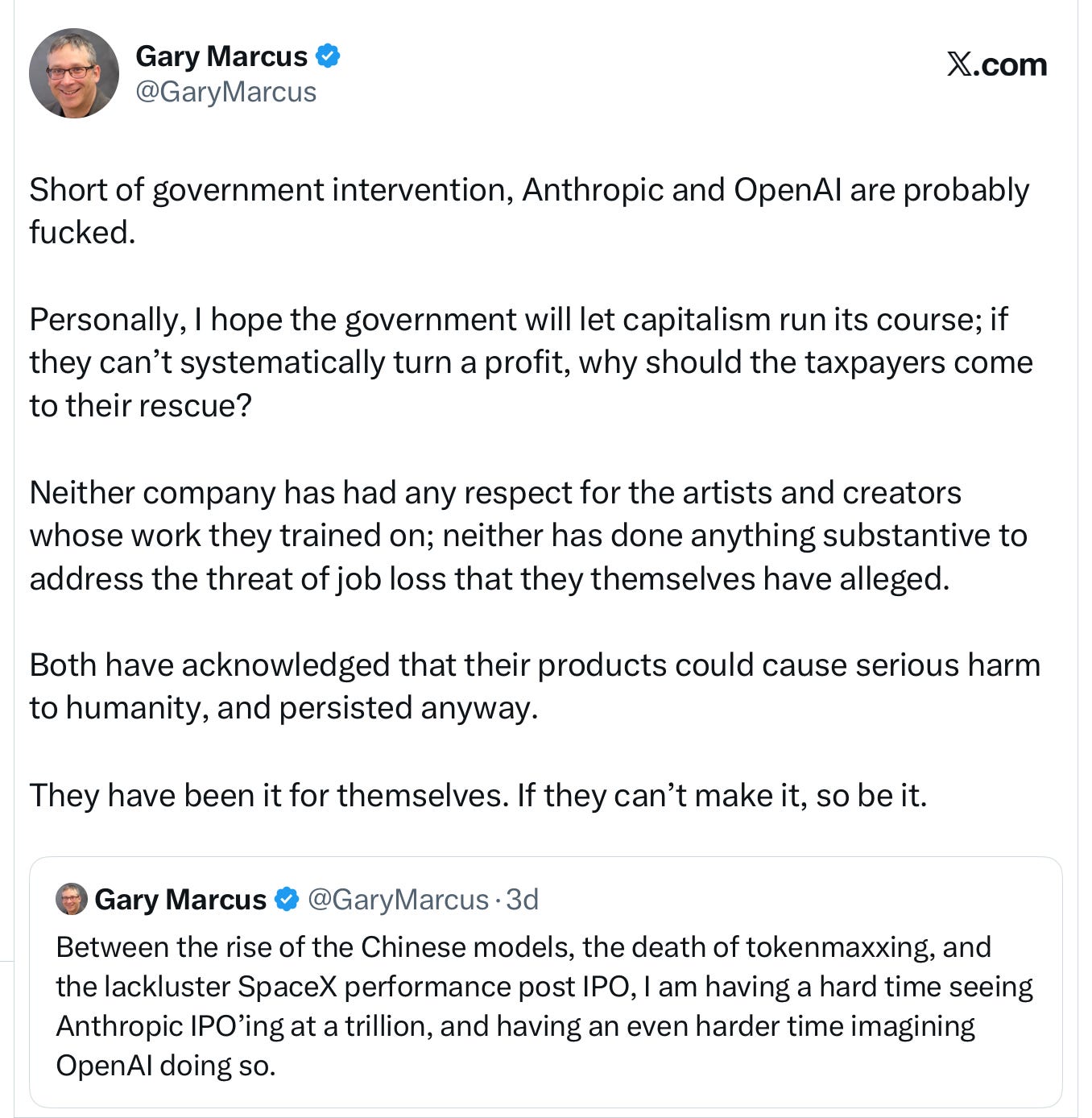
Bail out the big AI labs. Just no:
5. Ban Chinese models altogether. Axios thinks that might be in the works. Variant on the above; sure to raise prices to consumers, and stifle innovation.
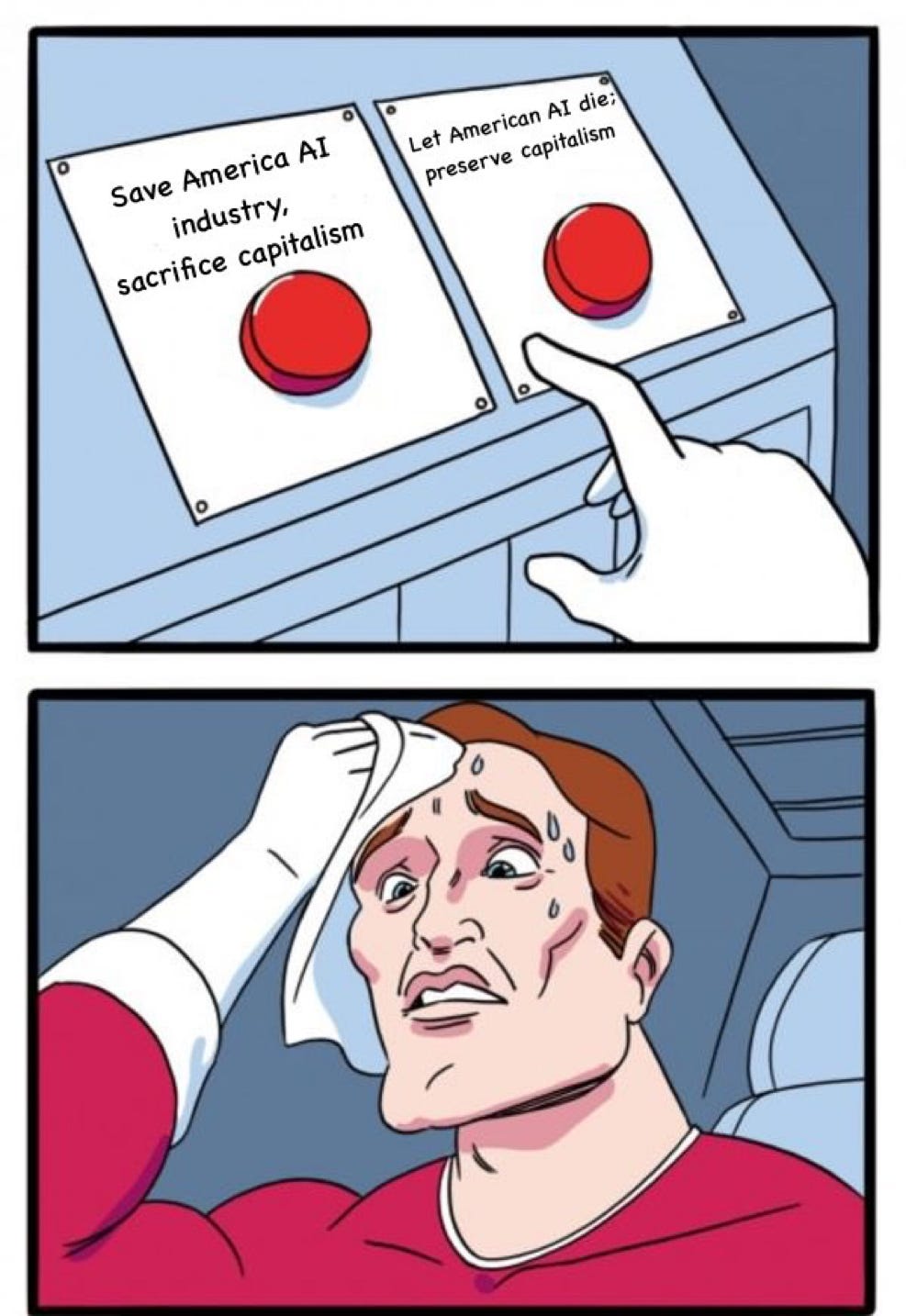
Even before I read the above rumors, I made a joke about this on X:
As investor and CEO Phil Libin put it to me in a message this morning, “The American system benefits when there’s free flow of capital, ideas, and people. We don’t need to “win” a zero-sum game. We win by transforming games to non-zero-sum. This is how we won the 20th century and it’s our best shot of winning the 21st.”
Buy out the big AI labs, OpenAI and Anthropic, altogether, for two cents on the dollar — which is generous, since they are both mostly money-losing ventures in an industry that has yet to convincingly establish profitability. Turn them into national laboratories, available to all accredited scientists through a competitive process. Since AI is bult on human IP that has largely been taken without compensation, there is poetic justice here, too. The downside is what unsavory things the government might do with the data, e..g, in terms of mass surveillance. Given that Hegseth blasted Anthropic for refusing to do just this, and given the current administration’s tendency to prosecute critics and enemies on thin grounds, we should worry about government abuse.
Give up on the zero-sum effort to “win” the AI war, and instead move towards making AI a global public good. In 2017 in the New York Times (based on a talk in 2016 at the conference AI for Good) I proposed a “CERN for AI”, writing
I look with envy at my peers in high-energy physics, and in particular at CERN, the European Organization for Nuclear Research, a huge, international collaboration, with thousands of scientists and billions of dollars of funding. They pursue ambitious, tightly defined projects (like using the Large Hadron Collider to discover the Higgs boson) and share their results with the world, rather than restricting them to a single country or corporation… An international A.I. mission .. could genuinely change the world for the better — the more so if it made A.I. a public good, rather than the property of a privileged few.
Maybe now is finally the moment? For a long time the odds of pulling this off seemed long, but maybe the time is right. China itself seems warm to something of the sort, per a speech that Xi Jinping just made, headlining an AI conference for the first time:
I don’t know whether to take Xi at face value — you can view his full talk here) – but the fact that he said this gives a tremendous opening for discussion. I still think putting AI in the public domain, with an international effort towards medicine and science, would be a good idea. Of the options I have discussed, it seems to me to be the most promising, a last-ditch way to turn AI, built on so much of the internet that was sourced from hard work and thinking of the public, largely without compensation, into a true public good for the world.
If Trump actually wants to earn a Nobel Peace Prize, this could be his chance. A decision to outlaw closed source AI — requiring all manufacturers to share their weights, architectures and training data with accredited scientists and research organizations — combined with a deal with China to dedicate AI to the public good – would be a great gift to humanity.
Gary Marcus proposed a CERN for AI in 2016, echoing it gently at the Senate in 2023, and would be thrilled to see some variation on that idea see the light of day.
In a later tweet, Dean claimed he was not proposing that the US adopt a regulatory moat to keep China out it, just stating it as inevitable. (Few people on X believe him; most seem him as retrenching in the face of huge opposition. I leave his intent open.)
Discussion about this post
The US isn’t going to win in quantum computing, either…if it doesn’t benefit humanity, how does anyone win?
Why is China always being mentioned? Open models are being developed all around the world, all open source technology is developed globally.
The idea it's possibly to ban open development in the ML or any other space is moronic and ridiculous. People elsewhere can just create their own version of it called something else, possibly even improving it further.
The future for Enterprise ML is models created and trained for specific use cases, using owned hardware which will give predictable (and easily controllable) costs. So ROI will be easily calculated and someone apart from the hardware manufacturers might actually make a profit out of all this.
LikeReply